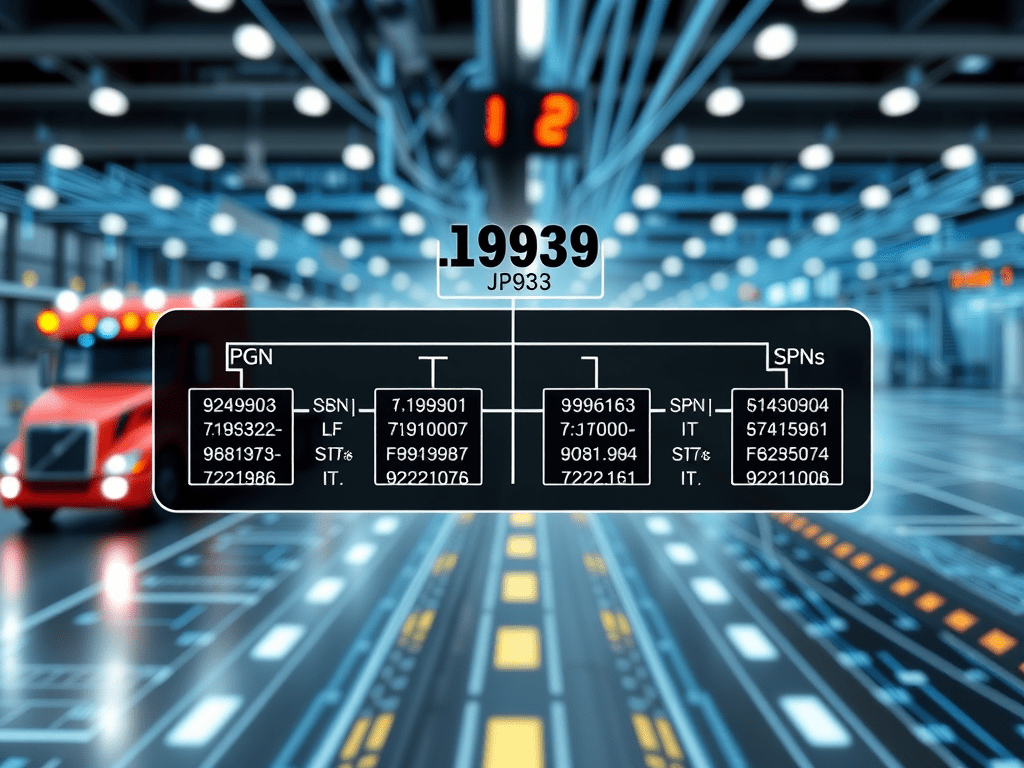
How J1939 Gives Meaning to Vehicle Data (Understanding PGNs and SPNs)
In earlier episodes, we explored why heavy vehicles need a digital communication system and how the CAN Bus physically carries information. But CAN alone only provides the road. For meaningful telematics, diagnostics, and ELD data collection, the industry needed a common language.
This is where J1939 comes in.In this episode, we explain how J1939 assigns structure, identity, and meaning to every message that travels across the CAN network.
Why J1939 Exists
CAN was designed to move data quickly, but it does not define what that data means. Without a standard protocol, every vehicle manufacturer would use its own message format, making cross-platform devices like ELDs impossible.
J1939 solves this by defining:
- What each message represents
- How data is organized
- How ECUs identify themselves
- How larger data sets (like VIN) are transferred
- How diagnostic information is reported
This universal structure allows ELDs to work across different brands, models, and years.
The Module Analogy: PGN as the Chapter, SPN as the Line
To understand J1939, think of vehicle data as a digital book.
PGN (Parameter Group Number) is the chapter.
SPN (Suspect Parameter Number) is the specific line within that chapter.
This structure ensures every piece of information has a predictable place.
Example:
- PGN for engine speed and torque data
- Inside it:
- SPN for engine speed
- SPN for percent torque
- SPN for accelerator pedal position
This allows an ELD to look at a message and immediately know which part represents what.
What Is a PGN?
A PGN describes a group of related data signals that belong together. It defines:
- What category of data is being sent
- How often it should be broadcast
- Whether it is global or targeted
- Which ECU is allowed or expected to send it
Some examples (simplified):
- Engine data
- Vehicle speed
- Fuel system information
- Diagnostic messages
When an ELD receives a PGN, it knows exactly which type of information is inside.
What Is an SPN?
SPNs are the individual parameters within a PGN. Each SPN is a specific data point with its own meaning.
Examples include:
- Engine RPM
- Throttle position
- Coolant temperature
- Odometer value
- Engine load
- Oil pressure
- Fault-related identifiers
SPNs also define:
- Data length (in bytes)
- Scaling (for converting raw values)
- Status types (on/off, available/not available)
This allows the ELD to convert raw bytes into understandable values such as kilometers per hour or engine revolutions.
Why PGNs and SPNs Are Critical for ELD Accuracy
An ELD is only as accurate as its ability to correctly interpret J1939 data. Some essential parameters depend directly on SPNs:
- Engine hours
- Vehicle speed
- Distance traveled
- Driving vs. idling time
- Diagnostic trouble codes
- Engine speed and load
HardFault’s firmware uses a structured decoding pipeline to ensure every SPN is interpreted with precision, regardless of manufacturer differences.
How J1939 Ensures Compatibility Across Vehicles
J1939 was created to unify communication across:
- Heavy trucks
- Buses
- Agricultural equipment
- Construction machinery
- Marine engines
For ELD manufacturers, this standardization is critical. Without J1939, every fleet would require a different hardware and software solution.
By following J1939, HardFault’s ELD can plug into virtually any commercial vehicle and immediately understand:
- What data is being broadcast
- How often it is sent
- Which ECU is sending the information
No reconfiguration. No brand-specific firmware needed.
What Happens When an ELD Receives a J1939 Message
When data arrives:
- The ELD identifies the PGN
- It checks the source (engine, transmission, retarder, etc.)
- It extracts SPNs inside the PGN
- It applies scaling and decoding rules
- It converts the values into meaningful metrics
- It stores or transmits the processed ELD data
This is how a raw byte turns into something useful like:
- Engine speed: 1550 RPM
- Vehicle speed: 62 km/h
- Engine hours: 8456.2 hours
Conclusion
J1939 adds structure and meaning to every message flowing through the vehicle’s CAN network. PGNs group related data, while SPNs define the exact parameters inside those groups.
Without J1939, developing a universal ELD or telematics system would be nearly impossible. With it, HardFault is able to create accurate, reliable, and compliant solutions that work across diverse vehicle platforms.
 HardFault
Leave a comment