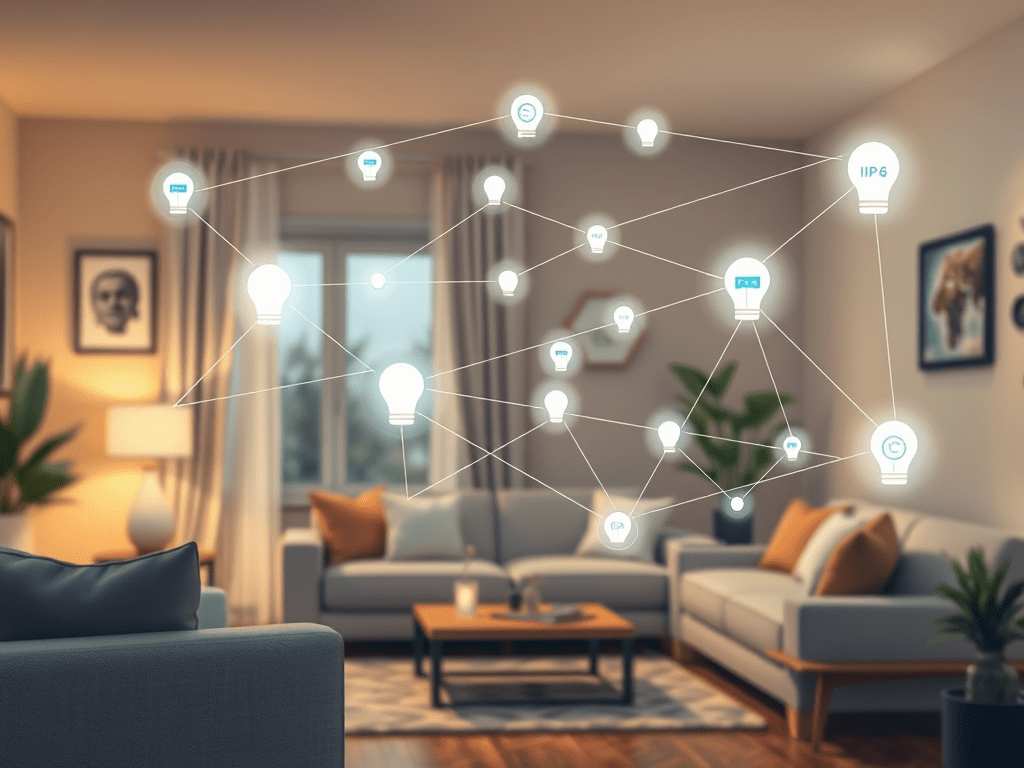
What Is Thread?
Thread is a low-power, IPv6-based mesh networking protocol designed specifically for IoT devices in home and building automation. Developed by the Thread Group (which includes Google Nest, Apple, and others), it addresses the limitations of older mesh protocols like Zigbee by offering secure, reliable, and scalable communication built on open standards.
Unlike Zigbee or Z-Wave, which require a dedicated gateway, Thread devices can communicate directly using IP addressing, making them ideal for integration with the internet and cloud services.
Why Thread Was Created
Thread was developed to overcome key challenges in existing smart home networks:
- Lack of interoperability across vendors.
- Single point of failure in centralized networks.
- High power consumption in some existing wireless protocols.
- Insecure communication channels for home automation.
Thread solves these with a self-healing mesh, end-to-end encryption, and native support for IPv6 over low-power wireless links.
Thread’s Core Features
1. IPv6-Based Communication
Thread uses 6LoWPAN (IPv6 over Low-power Wireless Personal Area Networks) to bring full IP networking to low-power, constrained devices. Every device gets its own unique IPv6 address, enabling direct communication with other IP-based devices and services.
2. Mesh Networking
Thread uses a true mesh topology with no single point of failure. Devices communicate peer-to-peer, with dynamic routing that adjusts to changes like node failure or signal interference.
3. Low Power Consumption
Thread is built on IEEE 802.15.4 at 2.4GHz, optimized for battery-powered devices. Devices can sleep when not active and wake up only when needed, significantly reducing energy usage.
4. Security
Thread implements banking-class AES encryption, secure device joining (commissioning), and whitelist-based communication. It supports end-to-end encryption and secure over-the-air (OTA) updates.
5. Reliability
Thanks to mesh routing and route redundancy, Thread ensures that data packets always find a path, even if individual nodes go offline. This is crucial for smart homes and critical automation.
Thread Device Roles
- Border Router: Connects the Thread mesh to other IP-based networks (like Wi-Fi or Ethernet).
- Router: Forwards messages in the mesh network and maintains child devices.
- Router Eligible End Device (REED): Can upgrade to a router when needed, enhancing scalability.
- End Device: Low-power node that only communicates through a parent router.
- Leader: Elected from routers, manages network parameters and coordination.
Comparison with Other Protocols
| Feature | Thread | Zigbee | Wi-Fi |
|---|---|---|---|
| IP Support | Yes (IPv6) | No | Yes |
| Mesh Topology | Yes | Yes | No |
| Power Efficiency | High | Medium | Low |
| Security | Strong | Moderate | Strong (varies) |
| Scalability | High | High | Limited |
Thread in the Real World
Thread is gaining adoption in smart homes through Matter, a unifying standard backed by Apple, Google, Amazon, and others. Matter runs over Thread to ensure seamless, cross-platform connectivity. This makes Thread a future-proof investment for smart home and industrial automation solutions.
 HardFault
Leave a comment